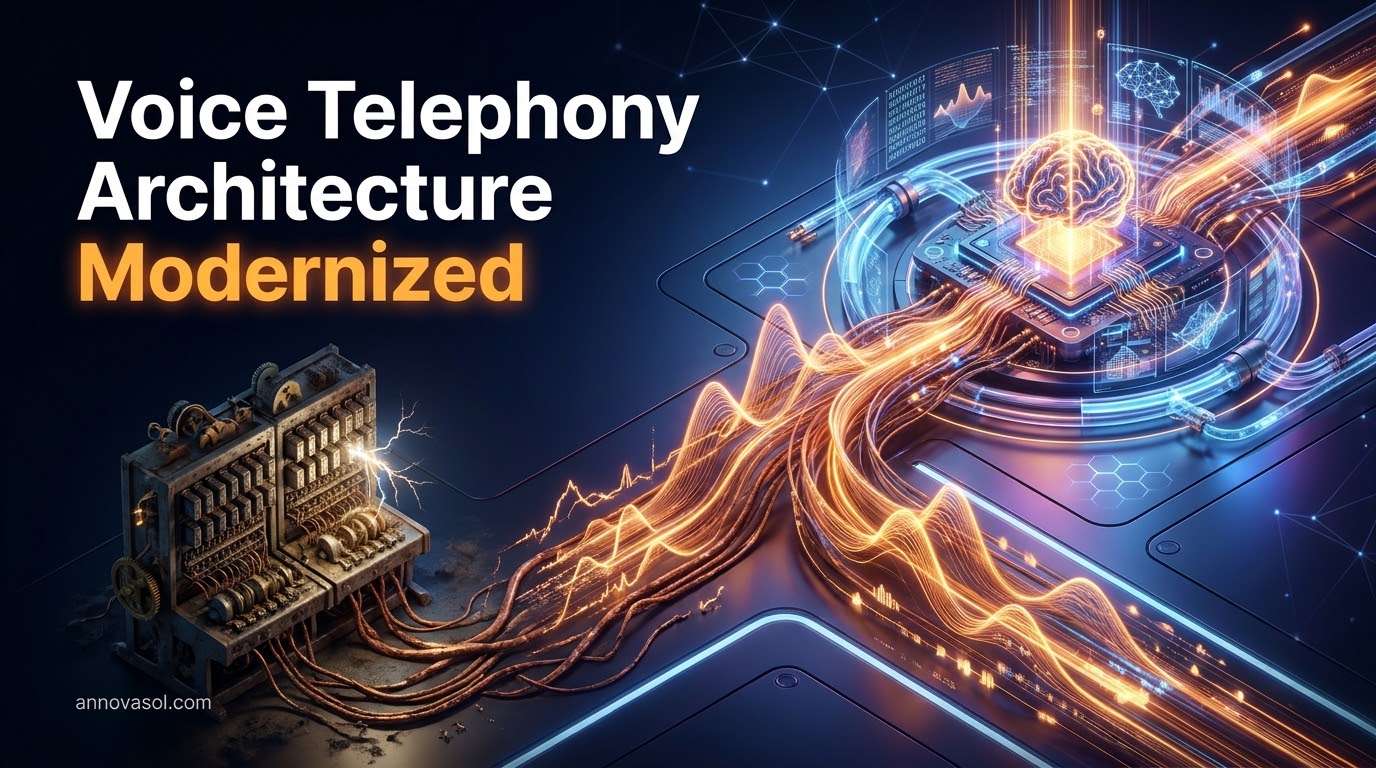
voice AIconversational AIIVR migrationcall center automation
AI Voice Agent vs Traditional IVR: Architecture & Costs
Compare an ai voice agent vs traditional ivr. Discover how voice AI replaces rigid phone trees, lowers cost per resolved call, and automates workflows.
Comparing an ai voice agent vs traditional ivr reveals fundamental differences in how organizations manage incoming customer communications. A caller dials your main support line with an urgent request: their delivery address changed after an order shipped, and they need immediate rerouting. Instead of reaching assistance, they meet a familiar prompt: "Press 1 for tracking, press 2 for billing, or press 3 to return to the main menu." None of these options solve the problem. After listening to nested audio prompts, the caller hangs up in frustration or presses zero repeatedly to force an agent transfer.
According to research from Metrigy, voice remains critical across the customer journey, being involved in 82% of all customer interactions in 2025, up from 77% in 2024. Yet the systems handling those calls are collapsing under modern expectations. Evaluating an ai voice agent vs traditional ivr is no longer just a superficial customer experience debate. It is an architectural shift from passive call routing to autonomous issue resolution.
1. Architectural Breakdown of an ai voice agent vs traditional ivr
To understand why legacy phone trees fail, consider the difference in how each system processes information. Traditional Interactive Voice Response relies on Dual Tone Multi Frequency signaling, which converts telephone keypad tones into routing signals. The logic is strictly deterministic and hardcoded into an Asterisk dialplan or cloud PBX workflow. Every path through the system must be manually anticipated and mapped by an engineer before deployment.
In contrast, an AI calling agent functions probabilistically. When comparing an ai voice agent vs traditional ivr, the distinction lies in cognitive orchestration:
[Inbound PSTN / SIP Call]
         │
         ▼
[Real-Time Media Stream (WebRTC / RTP)]
         │
         ▼
[Streaming Speech-to-Text (STT)]
         │
         ▼
[LLM Orchestration & Context Engine] ◄──► [Bi-Directional CRM/ERP APIs]
         │
         ▼
[Neural Text-to-Speech (TTS) Engine]
         │
         ▼
[Low-Latency Audio Delivery to Caller]
Traditional IVR systems demand that the caller translate their complex human intent into rigid, preselected categories. If a caller's query crosses departmental boundaries, the phone tree breaks. Conversational voice AI reverses this burden entirely. The system listens to natural speech, transcribes the voice stream in real time, interprets multi intent utterances through a large language model, queries external databases, and generates a conversational audio response within milliseconds.
Instead of navigating through static menus, callers converse naturally as they would with a seasoned tier one human specialist. The architecture unifies transcription, semantic reasoning, external tool execution, and voice synthesis into a cohesive streaming loop.
2. Feature Comparison Matrix: ai voice agent vs traditional ivr
When technical teams evaluate an ai voice agent vs traditional ivr, they frequently confuse conversational IVR with true agentic voice AI. Conversational IVR uses basic natural language understanding to classify a caller's intent, but it still shunts the caller into the same rigid decision tree. Autonomous voice agents, however, possess reasoning engines capable of multi turn problem solving.
| Operational Capability | Traditional DTMF IVR | Conversational IVR | Autonomous AI Voice Agent |
|---|---|---|---|
| Input Mechanism | Keypad digits (DTMF tones) | Directed keyword phrases | Open ended natural speech |
| Underlying Logic | Deterministic static trees | Intent mapping to static queues | Dynamic LLM reasoning and tools |
| Task Completion | Routing and canned playback | Routing and scripted lookups | Autonomous end to end resolution |
| System Interaction | Read only database queries | Limited API reads | Bi-directional API read and write |
| Context Retention | Lost between menu tiers | Lost upon queue transfer | Retained across turns and handoffs |
| Turn Taking & Interruption | Rigid audio playback locks | Pauses audio on loud input | Subsecond barge in with context |
| Maintenance Burden | High engineer hours per menu edit | Script retraining required | Prompt and schema adjustments |
As demonstrated above, an AI voice agent behaves as an autonomous digital specialist rather than a receptionist reading a switchboard directory. While legacy setups restrict callers to pre recorded audio tracks, modern voice AI synthesizes replies dynamically, drawing from live customer records and real time enterprise context.
3. Call Containment Dynamics: ai voice agent vs traditional ivr
Contact centers have spent decades optimizing for a misleading metric: IVR deflection. In a traditional setup, any call where the customer hangs up inside the menu tree before entering a human queue is logged as deflected. In practice, industry studies reveal that a massive share of those hang ups stem from customer abandonment, where the caller simply gave up in disgust.
True containment is not keeping a customer from reaching an agent. It is resolving the customer's intent completely on the first contact so they never need to call back.
Understanding containment in an ai voice agent vs traditional ivr deployment requires distinguishing between defensive deflection and verified resolution. A legacy IVR system cannot verify whether a caller who pressed 1 for account hours actually received the information they needed.
By contrast, conversational voice systems authenticate callers, parse natural questions, execute tasks, and verbally confirm resolution. According to Google Cloud, voice AI agents handle 70% of routine inbound calls without human intervention. Because the agent actively resolves the inquiry, data from NICE shows an improvement in first call resolution of 15%.
Furthermore, customer perception has transformed dramatically. Research from Zendesk indicates that customer satisfaction with AI voice agents reached 72%, up from 53% just three years prior. By answering calls on the first ring, voice agents deliver an 18% lift in customer satisfaction through round the clock availability, as reported by Zendesk.
For organizations managing customer retention, exploring ai customer service agent solutions for ecommerce illustrates how autonomous order tracking and return initiation replace clunky phone trees while boosting net retention rates.
4. Total Cost of Ownership: ai voice agent vs traditional ivr
Contact center leaders looking at the financial models of an ai voice agent vs traditional ivr often compare the raw per minute price of legacy telephony against compute intensive AI pipelines. At first glance, basic SIP trunks and IVR ports appear inexpensive. However, that perspective ignores the massive downstream cost of human queue overflow.
Traditional IVR Operational Cost:
[Telephony Port: $0.01/min] + [Failed Containment: 70%] ──► [Human Agent: $5.00 to $8.00/call]

Voice AI Operational Cost:
[Speech-to-Text] + [LLM Tokens] + [Text-to-Speech] + [SIP] ──► [Resolved Interaction: $0.50 to $1.00/call]
According to data published by IBM, the cost per interaction for AI voice is $0.50 to $1.00 compared to $5.00 to $8.00 for a human agent. When an IVR system fails to resolve an issue, it dumps the caller into a queue where human agent seat licenses, benefits, and telephony hold times accumulate rapidly. Benchmarks from Five9 demonstrate that AI voice cuts average handle time by 40%.
To understand implementation budgeting for modern infrastructure, reviewing an in depth buyer guide on AI receptionist costs provides practical clarity on transcription, model inference, and maintenance line items.
When human agents are shielded from repetitive inquiries like order statuses, appointment confirmations, and routine credential resets, operational strain drops. Research from Genesys notes a 25% reduction in agent burnout when AI agents handle routine calls. When considering an ai voice agent vs traditional ivr, organizations must calculate cost per resolved interaction rather than cost per telephony minute.
5. Enterprise API Integration for ai voice agent vs traditional ivr
The critical operational boundary separating systems in an ai voice agent vs traditional ivr comparison is bi-directional data flow. Traditional IVR systems are historically read only. A caller enters their account number, the IVR runs an SQL query against a billing database, and a text to speech synthesizer reads an account balance. If the caller wishes to update their account details, reschedule service, or process a payment, the IVR cannot orchestrate the transaction.
Modern voice AI agents operate as action taking workflows. By connecting conversational pipelines to REST APIs, webhooks, and enterprise orchestration platforms, the agent performs real time database writes during the phone call:
- Authentication: The agent validates the caller using caller ID matching, one time SMS passcodes, or spoken voice verification tokens.
- Read Verification: The agent pulls current state data from platforms like Salesforce, HubSpot, Zendesk, or custom SQL databases.
- Intent Execution: Using structured function calling, the model triggers actions, such as writing an updated delivery date to an ERP or creating a field service dispatch ticket.
- Synchronous Confirmation: The agent confirms the successful database commit back to the caller and sends an instant SMS summary before closing the session.
To see how backend orchestration functions in real operational environments, review our guide on implementing practical AI workflow automation.
At Annovasol, we build automation using n8n, Make, Zapier, or custom Python, deploying production stacks with Next.js, FastAPI, PostgreSQL, and AWS. We work with clients on a written scope and a fixed price agreed before building, demonstrating working software every two weeks. When evaluating legacy call systems, we also tell clients honestly when a problem does not need AI and solid software or simple automation is the better fit.
6. Telephony Engineering Challenges: ai voice agent vs traditional ivr
Transitioning phone support to conversational models requires mastering tough telephony engineering challenges. When examining an ai voice agent vs traditional ivr, legacy systems carry almost zero processing latency because audio files are triggered instantly by DTMF tones. Conversely, if an AI agent stumbles on audio latency, packet jitter, or background noise, caller confidence evaporates immediately.
Latency Budgets and Human Turn Taking
Natural human dialogue relies on rapid turn taking. When a conversational partner finishes a sentence, humans expect an audible response within a fraction of a second. Delays exceeding one second create awkward pauses, prompting callers to ask if the line is dead. To maintain conversational flow, the entire voice pipeline must complete within tight bounds:
- Endpointing and Audio Buffering: The engine uses neural voice activity detection to identify when the caller has truly finished speaking.
- Streaming Automatic Speech Recognition: Audio packets are transcribed incrementally over WebSockets rather than awaiting complete audio files.
- Time to First Token Generation: The language model streams text tokens immediately as they generate.
- Streaming Neural Speech Synthesis: The text to speech engine synthesizes audio chunks concurrently, delivering audio frames to the caller without perceptible hesitation.
Handling Caller Interruptions and Natural Barge In
A persistent flaw of traditional IVR is the audio lock. If a menu begins reading a long prompt, the caller must wait for the entire audio prompt to finish before the system accepts input. Voice AI implements real time barge in.
When the caller speaks while the agent is talking, acoustic echo cancellation filters the agent's own output out of the incoming audio stream. The voice activity detection layer immediately registers the caller's voice, stops playback instantly, and passes the new input to the context engine.
Caller speaks ──► Acoustic Echo Cancellation ──► Voice Activity Detection
                                                        │
                      ┌─────────────────────────────────┴───────────────────┐
                      ▼                                                     ▼
           Flush Audio Outbound Buffer                            Process New Utterance
         (Silence agent immediately)                         (Update conversation context)
Contextual Warm Transfers
When a call requires human escalation, an AI agent does not drop the caller into a blind queue. Instead, it executes a SIP referral or conference bridge with metadata payload.
The human agent receives a synchronized screen pop detailing the verified caller identity, complete call transcript, extracted sentiment, and exact reason for transfer. The caller never repeats their story, preserving customer goodwill and shortening human handling time.
7. Practical Migration Roadmap: ai voice agent vs traditional ivr
Operations leaders often hesitate to modernize their contact infrastructure because they fear disrupting active customer support channels. However, transitioning from a legacy setup within an ai voice agent vs traditional ivr project does not require ripping out your existing telephony stack.
By using SIP trunking, modern voice AI agents interface directly with existing contact center infrastructure, including Twilio, Genesys, Talkdesk, Five9, and self hosted Asterisk servers.
[Inbound Carrier]
       │
       ▼
[Existing PBX / SIP Router]
       │
       ├────► [Option A: Rule-Based Fallback IVR]
       │
       └────► [Option B: Voice AI Agent Cluster via SIP / WebSockets]
                     │
                     ▼
              [CRM / ERP APIs]
Follow this phased modernization framework to deploy voice AI reliably:
Phase 1: High Volume Intent Identification
Audit your historical call recordings and contact center logs to identify the top three repetitive inquiries that account for the majority of call volume. Common candidates include appointment rescheduling, order status lookups, and recurring billing inquiries.
Phase 2: SIP Proxy Configuration and Pilot Routing
Deploy a cloud voice agent and configure your existing PBX or telephony gateway to route a small percentage of incoming calls directly to the AI agent via a dedicated SIP trunk. Keep your existing DTMF IVR active as a fallback.
Phase 3: Bi-Directional Integration Testing
Connect the agent to your staging CRM and database environments. Test edge cases, including heavy background noise, rapid caller interruptions, and complex multi part requests. Ensure transactional write operations are idempotent to avoid duplicate records.
Phase 4: Production Rollout and Continuous Refinement
Shift production call traffic from the legacy IVR to the voice agent in structured increments: 10%, 25%, 50%, and finally 100%. Monitor real time dashboards for first call resolution, transfer rates, latency spikes, and customer sentiment.
The operational results of this migration are substantial. According to the RingCentral Agentic AI Trends 2026 report cited by Datamart, organizations deploying AI agents report 61% increased productivity, 58% faster workflows, 49% improved customer experience, and 45% improved customer satisfaction. In fact, 96% of business leaders agree that AI agents are essential to remaining competitive.
Replacing an obsolete touch tone phone tree with an intelligent voice AI layer transforms your contact center from an expensive friction point into an automated engine for customer satisfaction.
Sources
- Voice AI agents vs traditional IVR: What actually works better for ...
- AI Voice Assistant Statistics 2026 - AdAI News
Ready to Move Beyond Legacy Phone Trees?
At Annovasol AI, we build custom voice agents integrated directly into your existing PBX and CRM systems so your calls resolve autonomously without disrupting daily operations.
Frequently asked questions
What are the key differences between AI voice agents and traditional IVR systems?
An AI voice agent understands natural, open ended human speech and resolves complex inquiries autonomously, whereas a traditional IVR relies on rigid keypad menus or basic commands simply to route callers to queues. AI voice agents execute direct database actions, query live backend systems, and adapt dynamically to context, while legacy IVRs provide limited scripted routing that frequently frustrates callers and leads to high abandonment rates.
Is IVR considered AI?
Traditional touch tone IVR is not artificial intelligence because it operates strictly on hardcoded, deterministic rules and fixed keypad options. Modern conversational IVR incorporates basic natural language processing to direct calls, but it still lacks the autonomous reasoning, dynamic memory, tool calling capabilities, and problem solving adaptability of true agentic voice AI. Voice agents actually comprehend multi intent dialogue and carry out transactional workflows.
What does the voice AI agent replace in customer support calls?
Voice AI agents replace repetitive tier one support tasks, touch tone menu trees, and manual data intake, including appointment scheduling, order updates, and customer identity verification. They resolve routine inquiries end to end without transferring the caller, freeing human customer service representatives to focus entirely on complex, high value escalations that demand nuanced empathy, specialized troubleshooting, and creative judgment.
What is the best IVR platform?
The best IVR platform depends entirely on enterprise infrastructure requirements, with leading enterprise contact center solutions including Twilio, Genesys Cloud, Talkdesk, and Five9. However, leading organizations increasingly bypass standalone IVR menus altogether, embedding conversational voice AI platforms that resolve customer issues directly rather than merely organizing holding queues. These modern systems connect with your existing telephony layer to deliver automated resolutions.
How does voice AI improve call containment compared to traditional IVR?
Voice AI improves call containment by actively resolving customer inquiries within the conversation through real time database reads and writes rather than deflecting callers into queues. By understanding natural speech, managing multi intent queries, and updating external enterprise systems, voice agents complete tasks end to end. Callers achieve their exact goals immediately on the first attempt without needing to speak with a human.
How much does it cost to implement an AI voice agent vs. maintaining a traditional IVR?
Implementing an AI voice agent typically involves per minute compute fees alongside initial workflow integration, whereas traditional IVRs carry platform licensing, maintenance fees, and massive human agent labor costs. While IVR software appears inexpensive initially, voice AI dramatically reduces total cost per resolved call by eliminating human agent transfers, lowering handle times, and automating repetitive tier one support overhead entirely.
Can an AI voice agent transfer a call to a human agent with context (warm transfer)?
Yes, an AI voice agent can initiate an immediate warm transfer to a human specialist, passing along real time metadata, transcripts, and caller details. When transferring via SIP, the human representative receives a populated screen pop with verified identity information, intent summaries, and conversation context. This prevents caller frustration because customers never have to repeat their issue to the human agent.
How do voice AI agents handle background noise and caller interruptions (barge-in)?
Voice AI agents utilize acoustic echo cancellation and neural voice activity detection to filter out ambient noise and recognize caller speech instantly. If a customer interrupts while the agent is speaking, the system executes subsecond barge in by halting audio playback immediately and incorporating the interruption into context. The agent pauses its output smoothly, parses the caller statement, and answers naturally.
Do you have to replace your entire telephony stack or PBX to deploy voice AI?
You do not need to replace your PBX or existing telephony infrastructure to launch conversational voice AI. Modern voice agents integrate directly with existing systems such as Asterisk, FreePBX, Cisco, or cloud contact center platforms using standard SIP trunking, WebRTC connections, or simple call forwarding rules. Organizations can pilot voice agents alongside their current setup without downtime or disruptive infrastructure overhauls.
What happens when an AI voice agent hallucinates or cannot understand a caller's request?
Production voice AI agents employ strict prompt guardrails, deterministic business logic, and confidence scoring to eliminate model hallucinations during calls. If caller confidence drops below a defined threshold or an unmapped scenario emerges, the system executes an automated, graceful fallback or warm transfer to a human specialist, ensuring that callers always receive accurate and verified enterprise information without conversational breakdowns.
AT
Written by
AnnovaSol Team
Building production AI at AnnovaSol — agents, RAG, voice systems.
Keep reading
More from the blog
AI Receptionist for Small Business Cost: 2026 Buyer Guide
Evaluate ai receptionist for small business cost in 2026. Explore pricing models, hidden telephony fees, CRM workflows, and ROI math to boost your revenue.
October 26, 2026
AI Calling Agent for Real Estate: The 2026 Playbook
Deploy an ai calling agent for real estate to achieve 30 second lead response, slash ISA costs by 75 percent, and book more qualified buyer and seller showings.
October 24, 2026