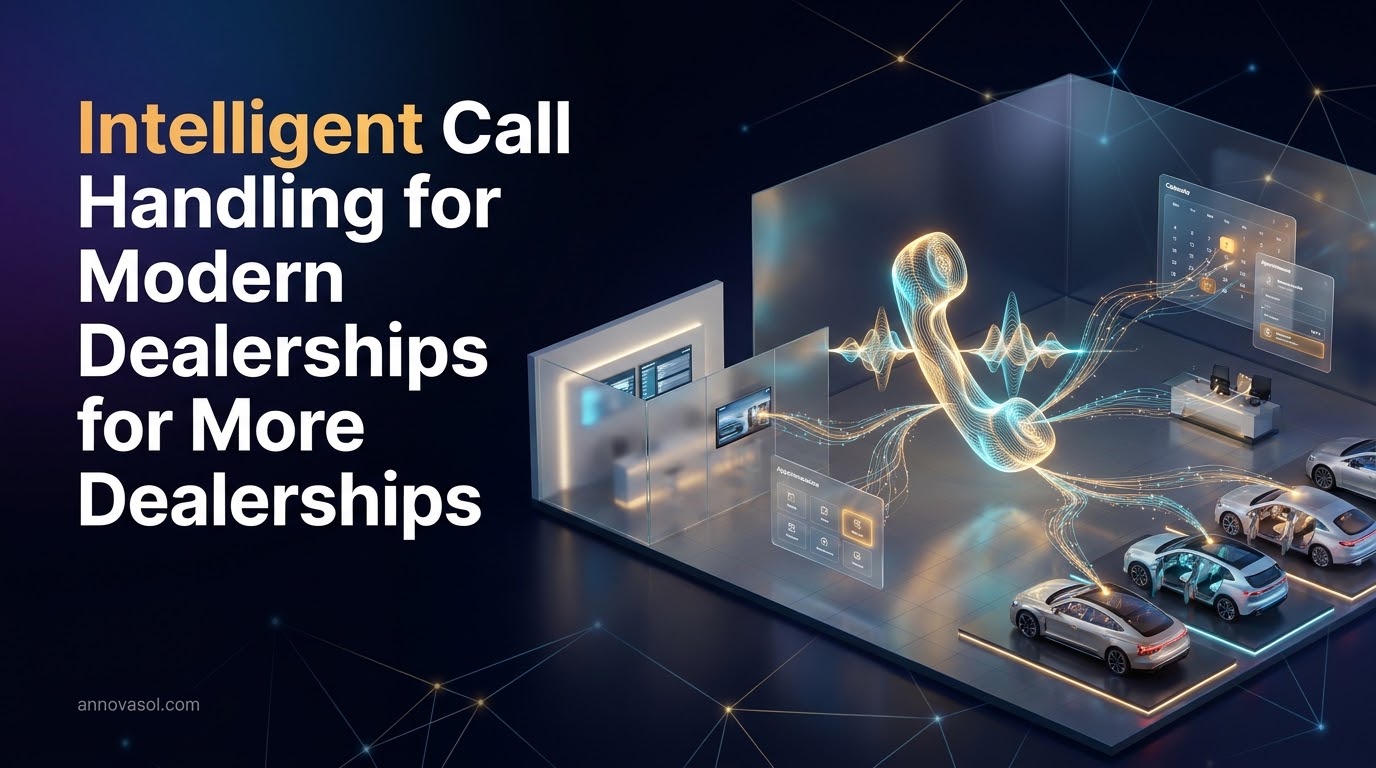
AI ReceptionistCar DealershipsAutomotive BDCCDK Global
AI Receptionist for Car Dealerships: CDK Setup & ROI Guide
Discover how deploying an ai receptionist for car dealerships captures missed service revenue, automates CDK Global booking, and slashes front desk overhead.
Over 158 service appointment calls slip through the cracks at the average franchise car dealership every single month, according to data from nearly 600 dealerships analyzed by Numa and reported by Flai. Inbound telephone calls remain the primary revenue engine for both showroom floors and fixed operations drives across North America. Yet traditional telephone switchboards, overwhelmed front desk coordinators, and understaffed service lanes routinely leave qualified buyers on indefinite hold. Implementing an ai receptionist for car dealerships provides an intelligent, automated voice layer that answers calls on the first ring, writes appointments directly into your dealer management software, and routes high intent sales conversations to your floor staff without friction.
Automotive retail operates on narrow vehicle margins, making aftersales maintenance and swift lead capture the foundation of store profitability. When incoming callers face endless interactive voice response menus or unanswered extensions, they hang up and dial the competing franchise down the street. Modern conversational voice agents solve this operational challenge by functioning as an autonomous front desk concierge capable of executing complex workflows in real time.
The Dealership Phone Crisis: Why 35% of Inbound Revenue Never Reaches Your Floor
Automotive retail spends tens of thousands of dollars each month on third party lead providers, search engine marketing, and local conquest campaigns to make phone lines ring. Despite this capital outlay, the majority of car dealerships suffer from an invisible communication breakdown. Industry data analyzed by Clean Fleet Report reveals that service departments represent around 50% of dealership gross profit, yet their phone lines face constant operational bottlenecks that cost stores tens of thousands of dollars each month in abandoned repair orders.
The financial cost of these dropped calls is substantial:
- Massive Service Revenue Leaks: With an industry average repair order value of $450, missing between 158 and 216 service appointment calls per month translates to $71,100 to $97,200 in monthly lost gross, or up to $1.17 million annually per store according to research reported by Flai.
- Wasted Paid Acquisition: According to NADA annual advertising data reported by Ringlead Automotive, dealerships spend an average of $45,000 monthly on advertising, yet over 40% of resulting opportunities are mishandled or missed at the switchboard.
- The Hold Time Defection Rate: A Car Wars benchmark analysis covering thousands of dealerships revealed that 31.8% of unconnected calls were customers who hung up while placed on hold, with the average hold time sitting at 3 minutes and 5 seconds as reported by Flai. Plum Voice research confirms that 60% of callers hang up after a single minute on hold, and 32% refuse to wait at all.
- The Phone Preference Reality: While automotive software vendors emphasize online booking widgets, research from CDK Global indicates that 64% of service customers schedule their appointments over the phone, while only 19% use online web schedulers.
The core operational bottleneck occurs between 8:00 AM and 11:30 AM every weekday. During this window, service advisors are actively greeting drive up check in guests, checking vehicle identification numbers, and conducting walkaround inspections. Meanwhile, switchboard operators face an overwhelming wave of incoming calls from vehicle owners seeking status updates or booking maintenance. When staff cannot answer within three rings, calls roll over to generic voicemails that 80% of vehicle owners refuse to leave.
What Is an AI Receptionist for Car Dealerships (And How It Replaces Legacy IVRs)?
An AI receptionist for car dealerships is an enterprise grade voice artificial intelligence solution specifically engineered to conduct human like, two way verbal conversations with dealership callers. Unlike legacy Interactive Voice Response (IVR) phone systems that force callers to listen to rigid numeric menus such as "press 1 for sales, press 2 for service", a conversational voice agent listens to natural human speech, interprets caller intent instantly, and answers questions using natural language.
Legacy automotive telephony has failed modern retail expectations. Traditional auto attendants do not understand conversational nuance, cannot pull information from backend databases, and frequently trap high value car shoppers inside circular transfer loops. If a customer says, "My check engine light came on in my 2023 Silverado and I need a loaner vehicle while you look at the transmission," an old phone tree is utterly helpless.
"Legacy voicemail systems and old school phone menus fail to meet modern consumer expectations. Today car buyers and owners demand instant gratification, whether they are checking if a specific truck is on the lot or trying to verify the completion status of a repair," explains automotive retail analysis from Clean Fleet Report.
A purpose built automotive voice agent manages this interaction seamlessly. Powered by modern speech to text, fine tuned automotive language models, and low latency streaming text to speech engines, the AI operates as a seasoned front desk professional. Emerging technology platforms such as Y Combinator backed Sandra AI highlight this evolution, developing autonomous voice employees that handle interactions across calls and messages to run dealership operations from front desk intake to back office DMS updates.
To explore how voice automation handles high volume booking workflows in specialized automotive facilities, review our guide on AI receptionist for auto repair shops.
The AI receptionist performs several mission critical tasks autonomously:
- Immediate Call Answer: Picks up 100% of incoming telephone traffic within one ring, completely eliminating customer hold times and busy signals.
- Contextual Intent Recognition: Distinguishes between scheduled maintenance requests, complex diagnostic concerns, parts inventory lookups, recall inquiries, and floor sales opportunities.
- Real Time Database Queries: Connects directly with service booking tools, Dealer Management Systems (DMS), and inventory databases to read live calendar slots and vehicle availability.
- Autonomous Booking and Dispatch: Collects driver contact details, selects appropriate labor operation codes, reserves service bays, and triggers SMS calendar confirmations without human intervention.
- Clean Human Handoffs: Identifies when a caller requires a human sales consultant or manager, initiating a warm transfer accompanied by full digital notes.
AI Receptionist vs. Automotive BDC: Cost, Turnover, and Booking Rate Comparison
To handle inbound call traffic, car dealers have historically relied on an internal Business Development Center (BDC) or an outsourced call center. While a well trained human BDC team can drive results, maintaining an internal call center creates severe financial and operational friction. When evaluating an ai receptionist vs automotive bdc, dealership general managers must consider labor expenses, staffing churn, and appointment conversion efficiency.
According to the National Automobile Dealers Association (NADA) Dealership Workforce Study reported by Super Producer, overall car dealership employee turnover reached 42%, with sales consultants and customer care representatives experiencing the sharpest turnover spikes. Constant staff turnover forces BDC directors into an expensive cycle of hiring, onboarding, and training representatives who often leave within six months.
Furthermore, human BDC agents are physically constrained to shift hours. When calls come in during evening hours, weekends, or early morning drive time commutes, inbound callers are shunted to third party call centers that lack store knowledge or dumped into unmonitored voicemail boxes.
The table below outlines the core operational and financial differences across traditional human BDC models and conversational voice AI:
| Operational Metric | Internal Dealership BDC | Outsourced Automotive BDC | Voice AI Receptionist |
|---|---|---|---|
| Monthly Cost Per Rooftop | $12,000 to $25,000 (3 to 5 full time agents) | $4,000 to $9,000 (retainer plus per lead fees) | $1,500 to $3,000 (flat or hybrid usage) |
| Annual Employee Turnover | 35% to 42% (constant recruiting cycle) | High agency agent turnover | 0% (zero attrition or retraining) |
| Answering Availability | Business hours only (40 to 55 hours per week) | Extended hours (often inconsistent) | 24/7/365 coverage (including holidays) |
| Average Hold Time | 2 to 4 minutes during peak morning rush | 1 to 3 minutes depending on call queue | 0 seconds (answers on first ring) |
| DMS / Scheduler Direct Entry | Manual data entry (frequent clerical errors) | Third party lead forms (requires store re keying) | Native bi directional API entry (instant sync) |
| Inbound Call Booking Rate | 45% to 55% during business hours | 35% to 45% (lower contextual authority) | 65% to 75% for routine service appointments |
| Concurrency Capacity | 1 call per active agent on the clock | Limited by purchased seat bandwidth | Infinite simultaneous call handling |
Deploying voice AI does not mean firing your top performing BDC managers. Instead, it automates the repetitive, low margin telephone volume: oil change appointments, tire rotations, service completion status checks, and business hour queries. This frees your experienced human BDC specialists to focus entirely on high margin outbound campaigns, lease renewal mining, and closing warm vehicle sales opportunities. To understand how dealerships build cross departmental automation architectures, read our guide on AI workflow automation for small business.
Deep CDK Global Integration: How Voice AI Books Directly into Your DMS & Scheduler
A voice agent that merely takes messages or forwards calls does not solve the dealership operational crisis. To deliver authentic return on investment, an ai receptionist with cdk global must achieve deep, bi directional integration with your central DMS and service scheduling software.
Modern dealership voice agents connect to CDK Drive, CDK Service, and specialized schedulers such as xTime or Reynolds and Reynolds through certified developer APIs and platforms like the CDK Fortellis Marketplace. As highlighted in recent marketplace integrations such as Car Wars Cari Service Scheduler on Fortellis, bidirectional synchronization pushes and pulls appointment data autonomously. This eliminates manual double entry, cuts administrative friction, and ensures that service drive capacity remains accurate across all customer touchpoints.
Real Time Customer and Vehicle Record Matching
When an inbound call arrives, the AI grabs the incoming telephone number via Caller ID (ANI) and performs an instantaneous database lookup in CDK Global. If the customer exists in your customer relationship management database, the AI greets them by name, references their registered vehicle year, make, and model, and checks for open recall campaigns or historical maintenance records. If the caller is using a new phone number, the agent captures their vehicle identification number (VIN) or license plate digits phonetically to build a new profile.
Intelligent Labor Operation Code Selection
One of the largest historical barriers to automated appointment scheduling has been the misuse of labor operation codes (op codes). If an untrained booking clerk or generic bot books a 60,000 mile major service under a quick lube oil change code, the service lane collapses under schedule congestion.
An automotive AI receptionist solves this by referencing your dealership specific op code catalog:
[Inbound Caller]
       │
       ▼
[Voice AI Speech Recognition & Intent Parsing]
       │
       ├─► Identifies: 2022 Ford F-150 / Brake Squeal & 30k Service
       │
       ▼
[Bi-Directional CDK Global / Fortellis API Query]
       │
       ├─► Matches Op Code: BRK01 (Front Brake Pad & Rotor Inspection)
       ├─► Matches Op Code: MNT30 (Factory 30k Mile Maintenance Package)
       ├─► Validates Shop Loading Capacity & Advisor Skill Matrix
       ├─► Checks Transportation Policy (Shuttle vs. Loaner Vehicle)
       │
       ▼
[Instant Appointment Write to CDK Service Calendar]
       │
       ▼
[Automated SMS Confirmation & Digital Add-to-Calendar Link]
Dynamic Shop Loading and Transportation Management
The AI respects the exact shop capacity rules established by your fixed operations director. It factors in technician skill level requirements, advisor appointment caps per hour, quick service express bay limits, and parts availability lead times. If a customer requests a loaner vehicle, the AI queries your fleet management module to verify whether a loaner vehicle is available before confirming that specific reservation slot. If no loaners remain, it offers alternative options such as your dealership courtesy shuttle or rideshare voucher credits.
Intelligent Call Routing: Handling Sales Ups, Parts Lookups, and Warm Human Handoffs
Dealerships handle a diverse mix of callers every day: sales leads looking for a specific VIN, repair customers checking on parts backorders, and drivers stuck on the roadside. Understanding how dealership ai receptionists route calls is critical to maintaining floor conversion rates and protecting dealership Customer Satisfaction Index (CSI) scores.
According to automotive lead research from Ringlead Automotive, 78% of car shoppers purchase from the first dealer that responds to their inquiry, and sales leads contacted within five minutes are 21 times more likely to convert. Voice AI acts as an instant qualification engine that separates administrative routine calls from live floor opportunities.
Contextual Sales Ups Routing
When a caller inquires about purchasing an in stock vehicle, trading in an existing vehicle, or obtaining promotional lease pricing, the AI does not attempt to negotiate vehicle pricing. Instead, it gathers preliminary qualification data:
- Exact year, make, model, or stock number of interest
- Intended purchase timeline (immediate, this week, browsing)
- Trade in vehicle details (year, mileage, condition)
- Financing versus cash preference
Once the caller is qualified, the voice system executes a Session Initiation Protocol (SIP) transfer to the showroom floor. The system utilizes intelligent hunt groups, ringing designated desk managers or available floor sales consultants. Simultaneously, the AI pushes a digital screen pop to the salesperson CRM or mobile device displaying the customer name, contact details, trade in info, and a full text transcription of the initial conversation. If no sales consultant answers after four rings, the AI offers the caller an immediate calendar appointment for an in person showroom test drive.
Parts Department Inventory Lookups
Parts departments are notorious for abandoned calls because parts counters are heavily occupied helping service technicians in the back bays. The AI receptionist handles standard parts inquiries by querying electronic parts catalogs. It checks stock availability for routine components such as batteries, tires, wiper blades, and brake rotors. If the item is in stock, the AI quotes retail pricing and offers to hold the part. If the inquiry requires looking up complex diagrams or special orders, it collects the vehicle VIN and forwards a detailed callback ticket directly to the parts manager inbox.
Warm Human Transfers for Emergency Inquiries
If a caller exhibits high emotional distress, reports an accident, or insists on speaking with a human manager, the AI immediately yields. It utilizes natural language sentiment analysis to detect frustration or urgency, gracefully stating: "I completely understand. Let me transfer you directly to our service manager right now." It executes a warm transfer, briefing the staff member on the line before bridging the call.
Car Dealership AI Receptionist Cost: Pricing Models, Hidden Fees, and Real ROI
When dealership executive leadership reviews automated phone platforms, evaluating car dealership ai receptionist cost against verifiable financial return is paramount. The automotive software market utilizes three primary pricing models:
- Flat Monthly Fee Per Rooftop: The dealership pays a fixed monthly software licensing rate, typically ranging from $1,500 to $3,500 per rooftop per month. This model provides budget predictability, includes unlimited inbound call handling minutes, and covers ongoing software maintenance and standard DMS updates.
- Usage Based Hybrid Model: The dealership pays a lower base platform fee (typically $500 to $1,000 monthly) plus a metered charge of $0.15 to $0.25 per minute of conversational voice processing. This model is often cost effective for single point stores with lower call volume.
- Performance Based Appointment Model: The vendor charges a nominal base software fee plus a performance fee of $15 to $35 per completed service appointment booked by the AI that actually shows up on the service drive.
For a comprehensive analysis of AI voice pricing across commercial platforms, review our guide on AI receptionist cost for small business.
Hidden Fees to Watch For
When evaluating vendor proposals, fixed ops directors and general managers must account for supplementary integration and telephony fees:
- DMS Integration Fees: CDK Global Fortellis or third party integration gateways may charge a monthly API access fee ranging from $200 to $500 per rooftop to maintain certified read and write privileges.
- SIP Trunking and Telecom Origination: Telephony carriage fees for incoming local or toll free numbers typically cost $0.01 to $0.03 per minute, unless bundled directly into the provider monthly subscription.
- Custom Prompting and Voice Cloning: Setting up customized brand voices or specialized multi language voice models may involve a one time setup fee between $1,000 and $3,000.
The Financial Return: Is Dealership AI Receptionist Worth It?
To determine whether is dealership ai receptionist worth it, consider a standard franchise dealership generating 2,500 inbound service calls per month:
- Current Missed Call Baseline: 158 missed service appointment calls per month (industry median).
- Average Repair Order (RO) Value: $450 in customer pay and warranty service revenue.
- AI Capture Rate: Assuming the voice agent successfully captures and books just 35% of those previously missed callers (55 additional booked ROs per month).
- Gross Revenue Recaptured: 55 recovered ROs multiplied by $450 average ticket equals $24,750 in gross service revenue recovered every single month.
- Annual Revenue Impact: Over $297,000 in reclaimed service department gross profit per year.
Against an annual software platform cost of approximately $24,000 ($2,000 per month), the dealership achieves an immediate 12 to 1 return on investment on fixed operations recovery alone, entirely excluding the financial benefit of captured vehicle sales leads and eliminated front desk overtime.
5 Step Implementation Playbook: Deploying Voice AI Without Service Drive Disruption
Transitioning your dealership frontline phone communication to conversational artificial intelligence can be executed smoothly without causing disruption to daily showroom operations or confusing existing customers. Follow this five step deployment framework:
Step 1: Telephony Audit and Call Flow Mapping
Begin by auditing your current phone system infrastructure. Document all existing direct inward dialing (DID) numbers, main switchboard lines, hunt groups, and rollover rules. Identify your peak traffic hours, current hold abandonment percentages, and typical after hours call volume. Map out exact routing preferences for sales opportunities, parts inquiries, service booking, and collision center questions.
Step 2: DMS and Scheduler API Configuration
Establish secure API credentials connecting your voice AI platform with your primary dealership management software. For CDK Global stores, authenticate through the CDK Partner Program or Fortellis Marketplace. Configure your service capacity limits, daily labor hour caps, advisor round robin assignment schedules, and transportation fleet rules. Import your complete catalog of factory maintenance op codes and local store service specials.
Step 3: Scripting, Voice Personality, and Prompt Engineering
Define the voice persona representing your dealership. Select a natural sounding, low latency voice profile that reflects your brand values. Program custom knowledge base documents containing your store physical address, service drive operating hours, holiday schedules, shuttle radius boundaries, and state inspection guidelines. Configure conversational fallback rules so the AI gracefully hands off complex inquiries to dealership management.
Step 4: Controlled Pilot Testing and Advisor Shadowing
Never route your primary switchboard phone number to an automated voice system on day one. Begin by pointing your after hours phone overflow or a dedicated service marketing tracking number to the AI receptionist. Have your service advisors and BDC managers monitor live transcripts and listen to recorded calls. Verify that op codes match customer requests accurately and that appointment reservations sync cleanly into your CDK calendar without creating double bookings.
Step 5: Full Switchboard Cutover and Ongoing Optimization
Once the system demonstrates a 95% or higher scheduling accuracy rate during the pilot phase, execute full switchboard cutover. Configure your primary phone lines to roll over to the AI receptionist on the third ring during busy daytime hours, and route 100% of calls to the AI during after hours windows. Review conversational analytics weekly to identify emerging customer questions, refine op code mappings, and maximize booking conversion rates across all departments.
Sources
Ready to Stop Losing Service Appointments and Floor Ups to Missed Calls?
At Annovasol AI, we design, build, and deploy custom voice AI receptionists integrated directly with your dealership DMS and CRM to handle inbound traffic 24/7. Our engineers configure exact op codes, scheduling rules, and warm transfer logic so your store captures every revenue opportunity.
Frequently asked questions
How much does an AI receptionist cost?
An AI receptionist for car dealerships typically costs between $1,500 and $3,000 per rooftop per month on a flat enterprise tier, or $500 to $1,000 per month plus $0.15 to $0.25 per minute when billed on a usage hybrid structure. Some specialized providers also charge a $15 to $30 performance fee per completed service appointment, which replaces expensive front desk staffing while scaling alongside your monthly repair order volume.
How to become a car dealership receptionist?
To become a car dealership receptionist, candidates must possess a high school diploma or equivalent, demonstrate strong verbal communication skills, understand basic computer workflows, and display exceptional customer service etiquette while greeting showroom guests and managing multi line telephone systems during peak showroom business hours. Familiarity with automotive dealer management systems such as CDK Global, Reynolds and Reynolds, or dealer customer relationship management software gives applicants a significant advantage when applying for front desk dealership positions.
How much do people sell an AI receptionist for?
Technology agencies and automotive software vendors typically sell an AI receptionist system for $1,500 to $4,500 per rooftop monthly to franchise dealers, while marketing agencies charge small independent shops $500 to $1,500 monthly plus setup fees ranging from $1,000 to $5,000 upfront. Pricing depends directly on integration depth, custom telephony configuration, proprietary voice tuning, and whether the system includes bi directional dealer management system scheduling alongside live human transfer capabilities.
Is an AI receptionist worth it?
An AI receptionist is well worth the investment for car dealerships because recapturing just three to five lost service appointments per month completely offsets the monthly platform expense, while protecting valuable customer satisfaction index scores and preventing high intent sales calls from abandoning. Dealerships save thousands in recurring business development center overtime, reduce turnover recruitment costs, and generate hundreds of thousands of dollars in annual fixed operations revenue by answering every inbound ring instantly.
How does an AI receptionist integrate with CDK Global and xTime?
An AI receptionist integrates directly with CDK Global and xTime using secure APIs through platforms like the Fortellis Marketplace, enabling the conversational voice agent to authenticate vehicle identification numbers, pull real time advisor availability, query service operation codes, and write booked appointments directly. This bi directional data sync eliminates duplicate calendar entries, verifies transportation choices like loaner vehicles, and pushes instant digital confirmation notices to callers via short message service without human manual input.
Can an AI receptionist distinguish between service booking, parts inventory, and showroom sales calls?
An AI receptionist accurately distinguishes between service booking, parts inventory inquiries, and showroom sales calls by leveraging modern natural language processing to evaluate caller intent in real time, bypassing rigid numeric touch tone menus to route callers to the correct destination or workflow. The system autonomously completes routine service scheduling, queries parts databases for availability, or executes a warm transfer to available floor sales consultants with transcribed customer notes pre populated on screen.
What happens when a caller demands a human or has an emergency repair inquiry?
When a dealership caller demands a human representative or reports an emergency repair situation, the AI receptionist immediately triggers a warm SIP transfer protocol to route the caller to an available service advisor, manager desk, or designated on call staff member without hesitation. If all human personnel are tied up with showroom customers, the voice agent captures critical diagnostic details, logs an urgent CRM ticket, and sends instant priority notifications via SMS to management.
Will an AI receptionist completely replace our dealership's BDC department?
An AI receptionist does not completely replace a dealership business development center but rather transforms it by eliminating repetitive tier one administrative call handling, allowing human BDC agents to focus exclusively on high margin outbound campaigns, VIP customer relationships, and complex vehicle sales negotiations. By automating routine appointment rescheduling, status lookups, and basic inventory checks, dealerships maintain a leaner, higher producing human team while drastically reducing stressful employee turnover.
How does the AI handle accents, slang, or callers who speak Spanish?
Modern automotive AI receptionists utilize advanced multilingual natural language models that automatically detect caller language within the first sentence, switching seamlessly between English and Spanish while interpreting regional accents, colloquial slang, and automotive industry jargon with exceptional contextual accuracy throughout the conversation. This bilingual fluency expands the dealership reachable market, accommodates diverse local demographics, and ensures non English speaking customers receive the same polite, instant service standard without requiring bilingual receptionists on staff.
How quickly can a dealership train and deploy an AI receptionist on live phone lines?
A car dealership can train and deploy an AI receptionist on live phone lines in seven to fourteen business days by connecting DMS APIs, importing dealership operation codes and inventory feeds, configuring intelligent call routing logic, and completing comprehensive test calls before public launch. Because modern voice platforms integrate directly via SIP trunking or call forwarding rules, deployment requires zero physical hardware installations and causes zero interruption to daily showroom or service drive operations.
AT
Written by
AnnovaSol Team
Building production AI at AnnovaSol — agents, RAG, voice systems.
Keep reading
More from the blog

AI Receptionist for Boutique Hotels: 2026 Guide to Direct Bookings
Discover how an AI receptionist for boutique hotels captures direct bookings, syncs with Cloudbeds, cuts night audit labor costs, and protects guest service.
November 14, 2026
AI Receptionist for Landscaping Companies: 2026 ROI Guide
Discover how an ai receptionist for landscaping companies captures leads, integrates with Jobber, handles rain delays, and scales your lawn business.
November 13, 2026
AI Receptionist for Chiropractic Clinics: The 2026 Guide
Discover how an ai receptionist for chiropractic clinics books exams, syncs ChiroTouch, lowers intake overhead, and prevents missed patient revenue.
November 9, 2026